string list parameter containing values week, month and quarter; defaulted to month. Note the capitalisation of the display as value. The value itself should all be lowercase as it will be referenced in calculations later.
pTimeFrame
integer parameter ranging from 12 to 36, with a step-size of 6 and defaulted to 24
pMoveAvg
integer parameter ranging from 3 to 12 with a step size of 3 and defaulted to 3
Creating the calculations
The viz needs to display a dynamic date based on thevalue of the pTimePortion parameter.
Display Date
DATE(DATETRUNC([pTimePortion],[Order Date]))
It also displays the moving average of Sales based on the pMoveAvg parameter.
Moving Avg
WINDOW_AVG(SUM([Sales]), -1*([pMoveAvg]-1), 0)
Note, as the moving average is to include the Sales value of the ‘current’ date, then we need to subtract 1 from the pMoveAvg parameter. Ie if the pMoveAcg parameter = 3, then we want to calculate the moving average over the ‘current’ mark plus the previous 2 marks, so -2 needs to be fed into the calculation.
Finally, we need to restrict the dates being displayed in the viz. For this I calculated
ie only include records where the Order Date is greater than pTimeFrame weeks/months/quarters prior to the Latest Date.
Building the viz
On a new sheet, display all the 3 parameters. The add Display Date as a continuous exact date (green pill) to columns and Sales to rows.
Add Moving Avg to rows, make dual axis and synchronise the axis. Adjust colours of the marks to suit.
Add Date to Display to the Filter shelf and set to True. Then add Sales and Moving Avg to the Tooltip of the All marks card, and adjust Tooltip accordingly.
Update the title of the sheet so it references the various parameters
Finally, tidy up by
removing row and column dividers
hiding the right hand axis (right click, uncheck show header)
editing the Display Date axis, so the title of the axis references the pTimePortion parameter (Note – I did find this gets ‘lost’ when publishing to Tableau Public, so I had to re-edit my viz after publishing to reapply this setting).
Then add to a dashboard, and use a horizontal layout container to organise the parameters across the top. My published viz is here.
Kyle set the challenge this week to demonstrate the use of some of the free Viz Extensions available for Tableau Desktop and Tableau Public.
Creating the Sales KPI Card
After connecting the Superstore dataset, format the Sales field to be $ with 0 dp. Then on a new sheet, select the Add Extension option from the Marks drop down
In the resulting pop-up window, search for KPI and select the KPI Card (BANs) extension by LaDataViz
then click Open on the resulting window, and OK to the Allow Extension dialog displayed. You will then be presented with details on how to use the extension
Drag Sales onto KPI and add Order Date to Time, changing the level to a continuous month (green pill).
Then click Format Extension and set each tab as below (I’ve highlighted the options I changed)
which results in
Update the Tooltip as required, then rename the sheet Sales KPI or similar
Creating the Orders KPI card
Create a new field
# Orders
COUNTD([Order ID])
Duplicate the Sales KPI sheet, then add # Orders to KPI instead of Sales. Format the extension so the KPI name is Orders (KPI tab) and remove the $ prefix from the number (Labels tab). Adjust the Tooltip as required and rename the sheet Orders KPI or similar
Creating the Profit Ratio KPI Card
Create a new field
Profit Ratio
SUM([Profit])/SUM([Sales])
and format to % with 1 dp
Duplicate the Sales KPI sheet, then add Profit Ratio to KPI instead of Sales. Format the extension so the KPI name is Profit Ratio (KPI tab) and change the number format style to percentage with 1 decimal (Labels tab). Adjust the Tooltip as required and rename the sheet Profit Ratio KPI or similar
Creating the Filter Control
On a new sheet, select the Add Extension from the marks dropdown, and this time when prompted find the Drill Down Filter extension by LaDataViz
Then add Category and Sub-Category to the Detail shelf. Then Format Extension. I just changed the font colour (Label tab) and background colour (sheet tab)
Building the dashboard
Create a dashboard. Format the dashboard to set the background colour – I set it to a mid-dark grey (#666666) via the Format > Dashboard from the menu.
Add a horizontal container, and add the 3 KPI card sheets side by side. Set the container to distribute contents evenly.
For each KPI card object within the container, adjust the outer padding so there’s 10pt around and between each object (depending which object you’re adjusting the left/right padding may be 10 or 5pt), set the inner padding to 5pt, and set the background to match the background you used on the sheets (I used #555555).
Add the Filter sheet as a floating object, position as required and then add the Show/Hide button via the context menu of the object. Move the floating button as required too
Add a dashboard filter action
Filter
On select of the Filter sheet, target the 3 KPI sheets, excluding all values when selection is cleared.
Add any additional dashboard content – title etc, and you should now have a working filterable dahsboard
It was my turn to set the 1st challenge for #WOW2026, and I went back in time to recreate something from over 10 years ago! I was at #DataFam Europe in December and the marvellous Andy Cotgreave represented Team DataFam at the tips and tricks battle against Team Tableau, and showcased this technique which he originally blogged about a long time ago. But for a lot of the audience, this was something they hadn’t seen before, so I figured I’d share it here too (as I’d never actually tried it out myself back then). This technique is limited in it’s use – it only really works if you are depicting a % value, and are using a dimension which has a small number of different, but well known values (in this case Segment only has 3 options which don’t change) – but it is a lot faster to render ‘on hover’ than the traditional VIT.
Build the basic map
Connect to the Superstore dataset and construct the basic filled map
Double click on State/Province to automatically generate a map of the US (set the Country/Region to USA via the Map > Edit Locations menu option if the US isn’t initially displayed)
Add Sales to Colour to change to a filled map
Format Sales to $ with 0dp
Edit the background layers of the map (Map > Background layers menu option) to remove all the pre-selected options, to produce a ‘clean’ outline of the US on a white background.
Hide the map option which allow you to pan/zoom etc (Map > Map Options menu option and uncheck all the preselected options)
Hide the unknown indicator in the bottom right (right-click > hide indicator)
Create the calculations
We need to capture the % sales for each Segment per State into it’s own ‘segment specific’ field (which is why this technique could be a bit onerous if you had a high cadence of values in your chosen dimension).
Typically, when working with a % value, we would just do SUM(IIF([Segment]=”Consumer”, [Sales],0))/SUM([Sales]), then format this to a %. The value actually stored in the calculation would be a number <= 1. But we need the number to be between 0 and 100 for a step later on, so we perform the % conversion in the calculation by multiplying by 100. To display as a %, the field is just then formatted to a number with 0 dp and with a % suffix
If you pop these fields onto a new sheet and build a tabular view, you can see them working
Now we know the % values for each Segment, we can create a calculation to represent the bars. Firstly copy the █ unicode block into notepad or similar. Then paste 9 more instances directly alongside. The copy all 10 instances and paste that another 10 times, so you have a string of 100 blocks like below
string parameter which contains this 100 block string of characters
Create a new field for each Segment which represents the ‘bar’ of % sales
% Consumer Bar
LEFT([100 Blocks],ROUND([Consumer % Sales]))
% Corporate Bar
LEFT([100 Blocks],ROUND([Corporate % Sales]))
% Home Office Bar
LEFT([100 Blocks],ROUND([Home Office % Sales]))
This is basically truncating the string of 100 blocks to the number of characters represented by the % value. So if the % value is 39%, the result will be a string of 39 blocks.
Add Consumer % Sales, Corporate % Sales, Home Office % Sales, % Consumer Bar, % Corporate Bar and % Home Office Bar to the Tooltip shelf then edit the Tooltip and arrange the layout like the visual below, colour coding the % Bar and % Sales values for each Segment as you wish (make sure you use <tab> on your keyboard after the Segment label to ensure the bars all start at the same point on each row.
Resolve wrapping
On testing this, I found that some lines in the Tooltip wrapped the text onto another line depending on how long the line was. And I couldn’t control the width of the window the tooltip would display in to prevent this.
I figured I needed to make all the lines shorter, so need to adjust the bar calculation to halve the length of the ‘bars’, but to be accurate, I need to incorporate the smaller block character
Half block
string parameter storing the single value of ▌
and then adjust the fields
% Consumer Bar
//to reduce length of bars, only display half the number of blocks – so 100% shows 50 blocks //but if 99% need to show 49 1/2 blocks, so add on the half block when number is odd (%2=1) IF ROUND([Consumer % Sales]) = 1 THEN [Half block] ELSEIF ROUND([Consumer % Sales])%2 =1 THEN LEFT([100 Blocks],(ROUND([Consumer % Sales])/2)) + [Half block] ELSE LEFT([100 Blocks],(ROUND([Consumer % Sales])/2)) END
% Corporate Bar
//to reduce length of bars, only display half the number of blocks – so 100% shows 50 blocks //but if 99% need to show 49 1/2 blocks, so add on the half block when number is odd (%2=1) IF ROUND([Corporate % Sales]) = 1 THEN [Half block] ELSEIF ROUND([Corporate % Sales])%2 =1 THEN LEFT([100 Blocks],(ROUND([Corporate % Sales])/2)) + [Half block] ELSE LEFT([100 Blocks],(ROUND([Corporate % Sales])/2)) END
% Home Office Bar
//to reduce length of bars, only display half the number of blocks – so 100% shows 50 blocks //but if 99% need to show 49 1/2 blocks, so add on the half block when number is odd (%2=1) IF ROUND([Home Office % Sales]) = 1 THEN [Half block] ELSEIF ROUND([Home Office % Sales])%2 =1 THEN LEFT([100 Blocks],(ROUND([Home Office % Sales])/2)) + [Half block] ELSE LEFT([100 Blocks],(ROUND([Home Office % Sales])/2)) END
Ta-dah!
Note – I did find that Wyoming with a 100% bar still wrapped on Desktop, but was fine when published to Tableau Public.
I finished up by removing row & column dividers, updating the title of the sheet, and then adding the sheet to a dashboard. My published viz is here.
IF [Count Regions] = 1 THEN MIN([Region]) + ‘ (‘ + STR([Count Regions]) + ‘)’ ELSEIF ([Count Regions]) = SUM({FIXED:COUNTD([Region])}) THEN ‘All Regions (‘ + STR([Count Regions]) + ‘)’ ELSE ‘Multiple Regions (‘ + STR([Count Regions]) + ‘)’ END
BC – Years
IF [Count Years] = 1 THEN STR(MIN(YEAR([Order Date]))) + ‘ (‘ + STR([Count Years]) + ‘)’ ELSEIF ([Count Years]) = SUM({FIXED:COUNTD(YEAR([Order Date]))}) THEN ‘All Years (‘ + STR([Count Years]) + ‘)’ ELSE ‘Multiple Years (‘ + STR([Count Years]) + ‘)’ END
On a new sheet, double click into the section beneath the marks card and create an ad-hoc dimension called ‘dummy’. Add BC-Region, BC- Ship Modes and BC – Years to the Detail shelf. From the Viz sheet you built the chart on, select each filter and set to Apply to Worksheets and select the new sheet. Show all the filters.
Change the mark type to polygon which will make the displayed mark disappear. Then update the sheet title referencing the breadcrumb fields we created. Test the functionality by changing the filter values. Name the sheet BC or similar.
On a dashboard, use a Vertical layout container and add a text field for the title, the BC sheet underneath (set to fit entire view), then add a horizontal layout container and move/add the filters into it. Then add the Viz sheet below, also set to fit entire view.
Format the horizontal container with a grey background then select the option to add hide/show button to it. The button will automatically be a floating object, so move it to where you want it to be. And then that should be it.
Yoshi & Yusuke presented this week’s #WOW2025 challenge live at the Agentforce World Tour in Tokyo. The key feature of this challenge is utilising the Pages shelf to step through how the shipment rankings for a set of products changes on a month-by-month basis.
Gathering the required files & modelling the data
I downloaded the Sample Super factory (subset).xlsx file from the provided google drive and connected directly to it. Relate Production_Plan_Output_Shipment to Product Master via the Product ID fields. I then added a Data Source Filter to restrict the data to Date: Year = 2025
I also downloaded all the images from the images folder and saved them in a new WOW2025_47 directory I created within my …\My Tableau Repository\Shapes\ directory.
Building the core rank calculation
On a new sheet, add Date to Columns and set to the Month level as a discrete (blue) pill. Add Product Name to Rows and Shipment Qty to Text.
Create a new field
Shipment Rank
RANK_UNIQUE(SUM([Shipment Qty]))
and add to the table. Adjust the table calculation setting, so the field is being computed explicitly by Product Name only.
Create another new field
Rank Display
IF [Shipment Rank] = 1 THEN ‘1st’ ELSEIF [Shipment Rank] =2 THEN ‘2nd’ ELSEIF [Shipment Rank] =3 THEN ‘3rd’ ELSE STR([Shipment Rank]) + ‘th’ END
Build the bar chart
On a new sheet, add Shipment Rank as a discrete (blue) pill to Rows and Shipment Qty to Columns and Product Name to Text.
Add Spiciness Level to Colour and change the field to be an Attribute so the table calc doesn’t break. Then add another instance of Product Name to the Detail shelf, and then click the icon to the left of the pill to add it to the Colour shelf, so there are 2 dimensions on the colour shelf. Adjust the colours to suit.
Tip – the quickest way to get the colours to be in a range is to edit colours > ctrl-click to multi select a set of colours, choose a diverging colour palette and click assign palette.
Edit the axis and reverse the axis. Adjust the size of the bars to make them a bit smaller. Adjust the label and match mark colour. Hide both the axis and the Shipment Rank header and all gridlines, and row/column dividers. Add Date at the Month level to the Pages shelf and update the sheet title.
Creating the Viz in Tooltip
On a new sheet ad Product ID to Rows. Change the mark type to Shape and add Product ID to shape. Edit the shapes to use the WOW2025_47 shapes added. As they are stored in alphabetical ordered, just use Assign Palette to set the right images to the right products. Hide the Product ID header row and remove any row/column dividers. Set the sheet to Entire View.
Back on the bar chart sheet, add Product ID to Detail and set as an Attribute so the table calc doesn’t break. Update the Tooltip to reference the relevant pieces of text and then add a reference to the VIT worksheet
The image should now display on hover of a bar.
Creating the bump chart
On a new sheet, add Date at the month level as a discrete (blue) pill to Columns and Rank Display to Rows. Add Product Name to Detail. Change the mark type to circle.
Add Spiciness Level to Colour and change the field to be an Attribute. Change the icon next to Product Name from Detail to Colour. The colours should automatically change and match the settings made against the bar chart.
Add Date at the month level as a discrete (blue) pill to the Pages shelf. The table will be filtered to January.
On the pages control, check the show history checkbox, then click on the ‘down arrow’ to display the additional history options. Set them as follows : show All marks, show both marks, allow fade and adjust the range, then format the trails to a narrower line at a lower opacity.
As you now press ‘play’ on the pages, the trails will display. HOWEVER (and this took some time to realise), in Desktop, the display of a circle on previous months does not work. Publish to cloud and it does. I did go down some dual axis related route until I discover this 😦
Add Product ID as an attributeto the Detail shelf and Shipment Qty to the Tooltip shelf and update the Tooltip and reference the Viz in Tooltip images sheet as before.
Then tidy up by
Removing row dividers
Adding column dividers
Adding column banding
Hide the Date label heading (right click > hide field labels for columns)
Hide the Rank Display label heading (right click > hide field labels for rows)
Update the title
Then add the sheets onto a dashboard and you should be good to go:-) My published viz is here.
For the bikes, we need to know how much charge it has left
Charge %
SUM([Current Range Meters]) / SUM([Max Range Meters])
format this to % with 0 dp
Add Bike Location to a new sheet. Add Bike Id to Detail and change the mark type to circle. Add Charge % to Colour, and adjust the colour palette as required, and also edit so it is fixed to range from 0 to 1 (ie 0-100%).
Adjust the opacity of the colour to around 70% and add a pale grey border around the circles. Click on the 1 null indicator to the bottom left and select filter data to exclude that record from the display.
Select Map > Map Options from the menu and uncheck all the values to prevent the map from bing manually zoomed in/ changed. Then select Map >Background Layers from the menu, and set the Style to dark and click the Streets,Highways etc map option.
Drag Station Location onto the canvas and drop when the Add a Marks Layer option appears. Add Name the Detail shelf and Num Bikes Available to Colour. Change the mark type to square and adjust the colour palette as required and fix to range from 0 to 50.
Adjust the opacity of the colour to around 70% and add a pale grey border around the circles. Then move the stations marks card so it is listed below the bikes marks card. This means the bikes are displayed ‘on top’
Identifying the selected bike
Create 3 parameters
pSelectedBike
string parameter defaulted to <empty string>
pLat
float parameter, defaulted to 38.9358 (this is the central point mentioned in the requirements)
pLon
float parameter defaulted to -77.1069 (this is the central point mentioned in the requirements)
Note – originally I planned to just capture the ID of the selected bike then determine the lat & lon of that bike using a FIXED LOD to in turn determine the selected bike’s location, but that really hampered the performance, so I just used the parameter action to capture the required Lat & Lon directly
Show the 3 parameters on the sheet.
Update the 3 entries with a Bike Id and its associated Lat & Lon values (eg Bike Id = 8ec444bc696c2c8837ca0dcad39de819 , Lat = 38.8965 , Lon = -77.0334)
We need to identify the selected bike on the map
Is Selected Bike
[Bike Id]=[pSelectedBike]
Add this to the Size shelf on the bikes marks card. Adjust the sizes so True is listed before False and the sizes are therefore reversed. You may need to adjust the slider on the Size shelf too.
Zooming in to the selected bike
Create a new field
Selected Bike Location
MAKEPOINT([pLat],[pLon])
then create a buffer of 2000m around this (the requirements state 1000m, but I found that there were free bikes that were over 1000m from their nearest station, and if they were clicked on in the grid, the map didn’t display).
Selected Bike Buffer
BUFFER([Selected Bike Location],2000,’m’)
We want the map to ‘zoom’ into this buffer area if a bike has been selected, but show all bikes & stations so we need
Within 2000m
([pSelectedBike]=”) OR ((INTERSECTS([Bike Location],[Selected Bike Buffer])) AND (INTERSECTS([Station Location],[Selected Bike Buffer])))
Add this to the Filter shelf and select True
The map should zoom in, and the bike selected should be quite central to the display (the middle point of the buffer). To verify this, create
Buffer for Zoom
IF [pSelectedBike] <> ” THEN [Selected Bike Buffer] END
Add this to the map as another marks layer, and the circular buffer ‘zone’ will be displayed (we’ll keep this here for now for validation purposes).
Reset the pSelectedBike to <empty> and set pLat and pLon back to their default values – the buffer circle disappears.
Kyle hinted that we need to make sure that on ‘zooming out’ the display should be centred on the default values. To ensure this, we want to create a buffer around that central point that encapsulates all the stations and bikes. So we need
Default Location
MAKEPOINT(38.9358,-77.1069)
Default Buffer
BUFFER([Default Location],30,’km’)
Choosing a 30km buffer was just trial and error.
Now update the Buffer for Zoom field to
IF [pSelectedBike] = ” // then we’re in the default ‘show all’ view THEN [Default Buffer] ELSE [Selected Bike Buffer] END
A buffer zone for the whole display is now shown
Ensure the buffer marks card is displayed at the bottom, reduce the opacity of the colour to 0 and remove any border to make the circle disappear. Then click on the eye symbol to the left of the marks card name to make the map layer disabled, so it doesn’t show up on hover.
Finally adjust the Tooltips on the relevant marks cards and then name the sheet Map or similar.
Building the Bike Selector Grid
To build this we will need to identify the closest station to each bike. First we need the distance between each bike and each station
Distance Bike to Station
DISTANCE([Bike Location], [Station Location],’m’)
and then we can create
Distance Bike to Closest Station
{FIXED [Bike Id]:MIN([Distance Bike to Station])}
On a new sheet add Bike Id to Detail and Distance Bike to Closet Station to Colour. Change the mark type to square. Sort the Bike Id by the field Distance Bike to Closet Station ascending.
Add Lat and Lon to the Detail shelf, and update the Tooltip as required. Name the sheet Bike Grid or similar.
Adding the interactivity
Add the two sheets onto a dahsboard, then create 3 dashboard parameter actions
Select Bike
On select of the Bike Grid sheet, set the pSelectedBike parameter with the value from the Bike Id field. When the selection is cleared, reset to <empty string>
Set Bike Lat
On select of the Bike Grid sheet, set the pLat parameter with the value from the Lat field. When the selection is cleared, reset to 38.9358
Set Bike Lon
On select of the Bike Grid sheet, set the pLon parameter with the value from the Lon field. When the selection is cleared, reset to -77.1069
And with that, hopefully the map should zoom in and out as required, albeit a bit slowly… (gif below recorded on Desktop)
The data provided contained 1 row per person. I started by creating a bin based on the Age field, which I dragged into the dimensions section of the data pane (above the line) after I connected to the data. Right click Age > Create Bins
Age Group
Create bins every 5 ‘units’
Adding this on to Rows you’ll see you get the relevant values
With this field, we can create the other calculations we will need
{FIXED [Age Group]:SUM( IIF([Gender]<>’Female’ AND [Gender]<>’Male’,1,0))}
Format both of these to 0 dp
Males
IIF([Gender]=’Male’,1,0)
Format this to 0dp
Females
IIF([Gender]=’Female’,-1,0)
Note, this is -1 due to how we’re going to plot on the chart, but we don’t want the labels displayed with negative numbers, so custom format this field to ,##0;#,##0
Headcount Gap
SUM([Males]) + SUM([Females])
Note – we’re adding since the Females value is actually a negative number
Also custom format this to ,##0;#,##0
Add Total Headcount to Rows and change to be discrete (blue pill). Add Other Gender to Rows too, and again change to discrete.
Add Females to Columns and then add Males to Columns too.
Make the chart dual axis and synchronise the axis. Change the mark type on the All marks card to bar. Adjust the Measure Names colour legend.
Make the rows a bit wider. On the All marks card, on the Label shelf, tick show mark labels and align the labels middle centre and bold.
Add Headcount Gap to Columns. Remove the Measure Names field from the Colour shelf on the Headcount Gap marks card.
Create a new field
Colour – Headcount Gap
[Headcount Gap] <0
and add to the Colour shelf on the Headcount Gap marks card and adjust colours accordingly.
I chose to make the tooltip on all the bars to match exactly and reference the information shown. For this I created some other fields
Tooltip – Least Gender
IIF(NOT([Colour – Headcount Gap]),’women’, ‘men’)
Tooltip – Most Gender
IIF([Colour – Headcount Gap],’women’, ‘men’)
On the All marks card, add Males, Females, Headcount Gap, Tooltip – Least Gender and Tooltip – Most Gender to the Tooltip shelf and adjust the tooltip as required
Add a constant 0 reference line that displays a solid black line to both the Female axis and the Headcount Gap axis.
Finally tidy up by
Hide the top axis (uncheck show header)
Editing the title of the Female axis to read Headcount
Remove all gridlines
Remove column dividers
Update the viz title.
Add the sheet to a dashboard and ta-dah! My published viz is here.
For this week’s challenge, we’re using the data from a previous challenge and visualising it using Sam Parson’s ‘satellite’ chart idea – see here.
Modelling the data
Connect to the Food Self-Sufficiency csv file then add another connection to the Circle_Scaffold excel file. Relate the two together using a relationship calculation where 1 = 1 (ie relate every row in left hand data source to every row in the right hand).
Since we only care about data from FY2019, add a data source filter to set Fiscal Year = FY2019.
This saves us from having to apply that filter to each sheet we build.
Building a single spiral
On a new sheet, add Prefecture to the Filter shelf and select Akita-ken (which is near the top of the list and has a % value over 200%).
Create a parameter
pMinRadius
integer parameter defaulted to 500
To build the spiral, we need to plot a mark for every percentage point from 0 up to the Food Self-Sufficiency % value. For this we will need to determine an (x,y) coordinate value for each point, which will require some trigonometry, based on the diagram below
For each point on the circle, we will need to identify the x & y position of where the radius intersects the edge of the circle. As we are building a spiral, the radius of the circle will increase as we move around each percentage point, so we need
Radius
[pMinRadius]+[Path Percent Point]
We then need to determine the angle θ. As a circle is 360°, and a complete circle represents 100%, then 1% is 360/100, so the angle (in radians) for each % point plotted round the circle can be calculated as
Angle
RADIANS([Path Percent Point] * (360/100))
X
(SIN([Angle]) * [Radius])/360
Y
(COS([Angle]) * [Radius])/360
Now create the point
Spiral Point
MAKEPOINT([X],[Y])
Note– the X & Y values are divided by 360 due to the spiral we’re building and the increasing radius when displayed using map layers. If we were just plotting X against Y and not using map layers, this wouldn’t be required.
Double click on Spiral Point to automatically add Longitude and Latitude fields to the sheet.
Change the mark type to line and then add Path Percent Point to the Path shelf.
Add Prefecture to the Detail shelf, as it’ll be needed later when we build the trellis and remove the filter.
At this point, the spiral is showing 3 complete revolutions, as the data in the circle_scaffold data set contains info for up to 300%. We need to restrict it so we only show up to the Self-sufficiency ratio… so we need
Filter Percent PointDisplayed
[Path Percent Point] <=[Self-sufficiency ratio for food in calorie base 【%】]
Add this to Filter shelf and set to True.
We now want to colour the spiral based on the percentage point associated to each mark plotted being <100%, between 100% & 199% or >= 200%, so we can use
Colour – Spiral
FLOOR([Path Percent Point]/100)
which will return an integer of 0, 1, or 2
Change this field to be discrete and then add it to the colour shelf and adjust colours accordingly.
Now obviously, you might be thinking things aren’t quite right – we’re not starting at the top and rotating differently. Simply pressing the swap rows and columns icon in the menu bar will resolve this, but if we do that too early, we lose the ability to add map layers, so leave as is for now.
Add the label map layer
Create a 0 point
Zero
MAKEPOINT(0,0)
Drag this onto the canvas and drop when the Add a Marks Layer option appears
This has the effect of creating a 2nd marks card
and now we have this, we can press the swap rows and columns icon in the menu bar to get the start of the spiral at X=0
Change the mark type to circle and add Self-sufficiency ratio… and Prefecture to the Label shelf. Adjust the font style and align centrally. Set the colour of the circle to white and increase the size. Move the Zero marks card to be below the Spiral Point marks card.
Rename the marks cards if you wish.
Add the starting point map layer
We need to create a point for the start of each line which is at the 0% mark
Start Point
MAKEPOINT((IF [Path Percent Point] = 0 THEN [X] END), (IF [Path Percent Point] = 0 THEN [Y] END))
Add this as a new marks layer. Change the mark type to circle and increase the size a bit. Colour the mark to the same base colour you used for your <100% range and remove the border. Rename the marks card to 3.Start Point
Add the end point map layers
Create a new point to represent the end of each line
End Point
MAKEPOINT((IF [Path Percent Point]= [Self-sufficiency ratio for food in calorie base 【%】] THEN [X] END), (IF [Path Percent Point]= [Self-sufficiency ratio for food in calorie base 【%】] THEN [Y] END))
Add this as a new marks layer. Change the mark type to circle and increase the size a bit. Add Colour-Spiral to the Colour shelf as a discrete dimension (blue disaggregated pill) and remove the border. Rename the marks card to 4.End Point Outer.
Add another instance of End Point as another marks layer. Again change the mark type to circle and adjust the size so it is smaller than the previous circle, and set the Colour to white. Rename the marks card to 5.End Point Inner.
Tidy up by
removing the Tooltip from each layer
disabling selection of each map layer (so nothing happens when you hover over it)
Hide the axis
Remove axis rulers and gridlines, but make sure the zero lines are shown
Hide the null indicator
Name the sheet Single Spiral or similar.
Building the trellis
Duplicate the single spiral (so if things go awry, you can get back to this). Then start by adding Prefecture to the Detail sheet of all the marks card.
When creating trellis charts, we need to create fields that represent which row and which column each Prefecture should sit in. There’s lots of blogs on creating trellis charts. As we know the number of rows and columns we need, I created
Cols
INT((INDEX()-1)%10)
Rows
INT((INDEX()-1)/10)
and make both fields discrete.
Add Cols to Columns and Rows to Rows. Adjust the table calculation setting of each field so it is computing by Prefecture only, and custom sorted descending by Self-sufficiency ratio…
Then show the Prefecture filter and select all values to display the ordered set of Prefectures.
Hide the Rows and Cols fields, remove row & column dividers. Adjust the size of the start and end point circles to suit, and if the zero lines aren’t showing, reduce the size of the label circle map layer and fit to Entire View.
Then name this sheet Trellis or similar and add to the dashboard.
I built an initial version of the heatmap only, which I’ve published here, but I couldn’t get the display to match Valerija’s when I clicked on it. (Note – I wasn’t bothered about Viz in Tooltip part at this point). I used 2 dimensions to display the yellow header section, and you can see below, when clicking, this is noticeable. But Valerija’s solution treats the header as a single entity.
I couldn’t figure out how she’d managed this, so I had to have a look at the solution, and then I built my own instance, which is what I’ll now blog about.
Defining the core fields
Connect to the datasource and add a data source filter to restrict the data by the latest year (as I used Superstore 2025, I filtered to 2025). Doing this meant I didn’t have to worry about adding worksheet level filter fields.
On a new sheet add Category and Sub-Category to Rows and add Sales to Text and then sort descending so you can see the data we need to work with. Format Sales to be $ to 0 dp.
Create a new field
Sales by Cat Rank
RANK(SUM([Sales]))
change it to be discrete and then add to Rows. Adjust the setting of the table calculation so it is computing by Sub-Category only, so the ranking restarts for each Category
We will also need to display the Category in upper case, so create
Category Upper
UPPER([Category])
and add to Rows.
Having this tabular layout just lets us clarify how the table calculation will be working.
Building the Heatmap Table
On a new sheet, add Category to Columns and Sub-Category and Sales to Text and align centrally (Note – I originally put Category Upper on the columns, and then changed later after taking all the screen shots)
Add Sales by Cat Rank to Rows. Change it to a continuous (green) pill and edit the axis to be reversed. Adjust the table calculation so it is computing by Sub-Category only.
Create a new field
One
1
Change the mark type to ganttbar and add One to the Size shelf, setting the aggregation to Avg. Increase the size of the mark via the Size shelf to as large as possible. Add Sales to Colour then add a white border.
We need the axis numbers to be central to the ‘row’, so to fix this, double click into the Sales by Cat Rank pill and change it to subtract 0.5 ( [Sales by Cat Rank] -0.5 )
Re-edit the axis to reverse it again.
So our ‘table’ is now displaying data on a axis from 0.5 up to 9.5. To add the header, we’re going to plot another mark at -0.5, so we can display a section of the same size as the existing ones. For this, double click into Rows and type MIN(-0.5).
This has the effect of creating a second marks card
Remove Sales from Colour and Sub-Category from Label. Add Category Upper to Label. Adjust the label text alignment and formatting and change the Colour to yellow.
Make the chart dual axis and synchronise the axis and we now have the required display.
Tidy up by
Remove row & column dividers
Remove gridlines, zero lines & axis ticks
Hide the right hand axis (right click > uncheck show header)
Hide the Category Upper column labels (right click pill > uncheck show header)
Remove the left hand axis title
Fix the left hand axis from -0.5 to 9.5
Format the axis with a custom formatting of #,##0;-#,##0;TOTAL so that 0 is displayed as the word TOTAL (this is very sneaky by the way, and took me a while to work out)
Then format the font to be bold
Adjust the Tooltip on the Sales by Cat Rank marks card to display the Sub-Category and Sales value.
Delete the text from the Tooltip on the MIN(-0.5) marks card
Name the sheet Table or similar
Building the Viz in Tooltip
On a new sheet add Order Date to Columns at the discrete month level (blue pill) and add Sales to Rows. Add Sub-Category and Category to Detail. Format the date axis so the dates are just using First Letter.
Create a new parameter
pSubCat
string parameter defaulted to Bookcases
Then create a field
Is Selected SubCat
[Sub-Category] = [pSubCat]
and add to the Colour shelf. Adjust accordingly, then make sure True is listed first in the legend, so the line is ‘on top’
Create a new field
Label Line
IF [Is Selected SubCat] THEN [Sub-Category] END
and add to the Label shelf and update to allow marks to overlap. Hide the Order Date label heading (right click > hide field labels for columns). Title the chart Line or similar
Remove gridlines and row/column dividers
Go back to the Table sheet, and update the Tooltip of the Sales by Cat Rank marks card to reference the Line chart and update the filter to pass as just <Category>
Adding the final interactivity
Create a dashboard and add the Table sheet. Then add a parameter action
Set Sub Cat Param
On hover of the Table sheet, set the pSubCat parameter with the value from the Sub-Category field, setting the value to <empty string> when the selection is cleared.
If all has been applied, then the line chart should just display the lines associated to the Sub-Categories in the same Category
For this week’s challenge, Yusuke asked us to provide a solution to allow charts to be coloured by different dimension, but he sprinkled a few extras in just for good measure 🙂
Defining the parameter
The key driver here is going to be the use of a parameter to define the dimension we need to colour by.
pColourBy
string parameter defaulted to Order Date, listing the 4 options as below
We then need a field that uses this parameter to define the actual dimension we’ll colour by
Colour
CASE [pColourBy] WHEN ‘Order Date’ THEN STR(YEAR([Order Date])) WHEN ‘Region’ THEN [Region] WHEN ‘Category’ THEN [Category] WHEN ‘Segment’ THEN [Segment] END
Building the Order Date chart
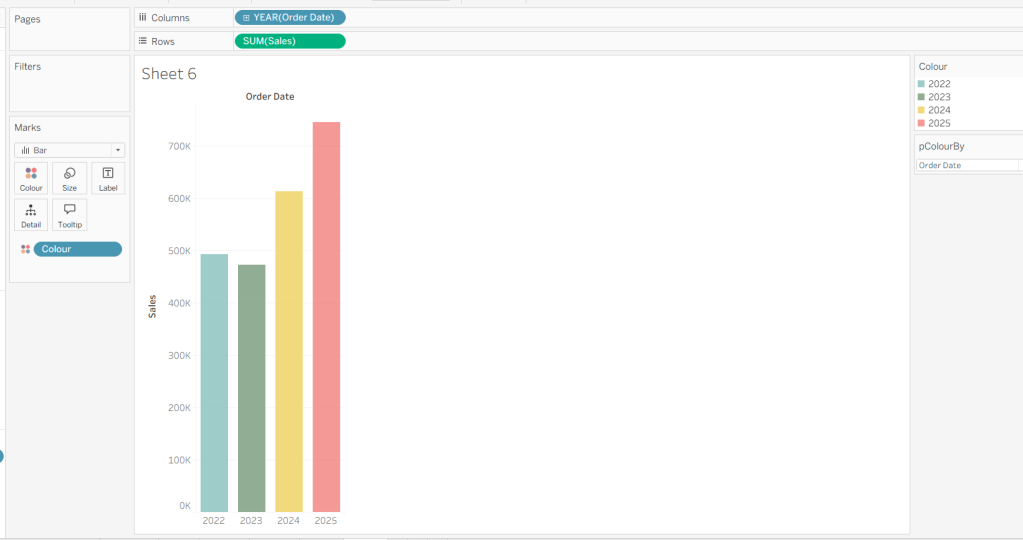
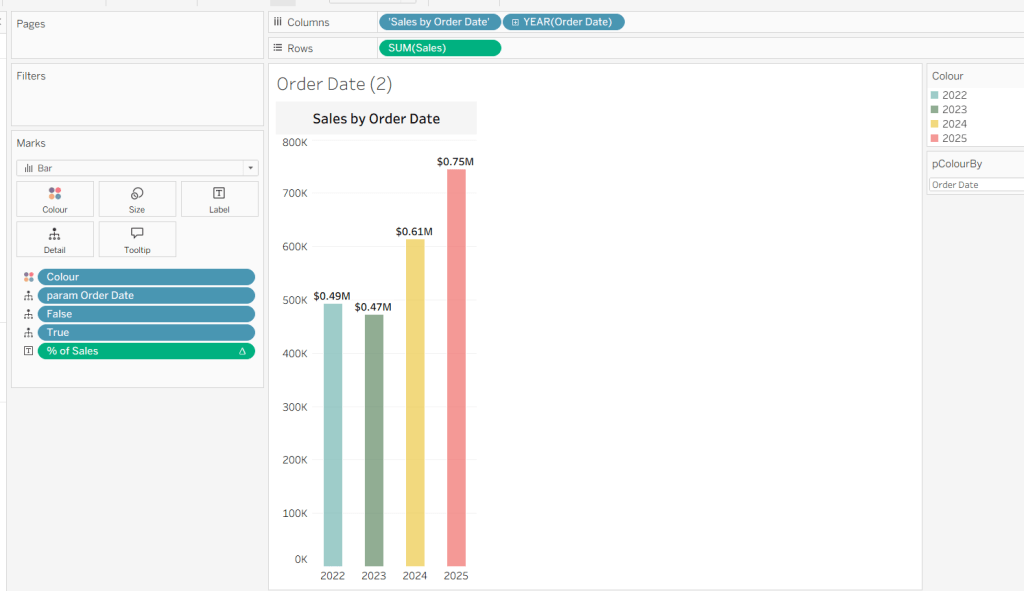
On a new sheet, add Order Date to Columns and Sales to Rows. Change the mark type to Bar and add Colour to the Colour shelf. Adjust the colours to suit, set the opacity to 70% and add a white border. Show the pColourBy parameter.
Change the options in the pColourBy parameter and each time readjust the colours as you wish.
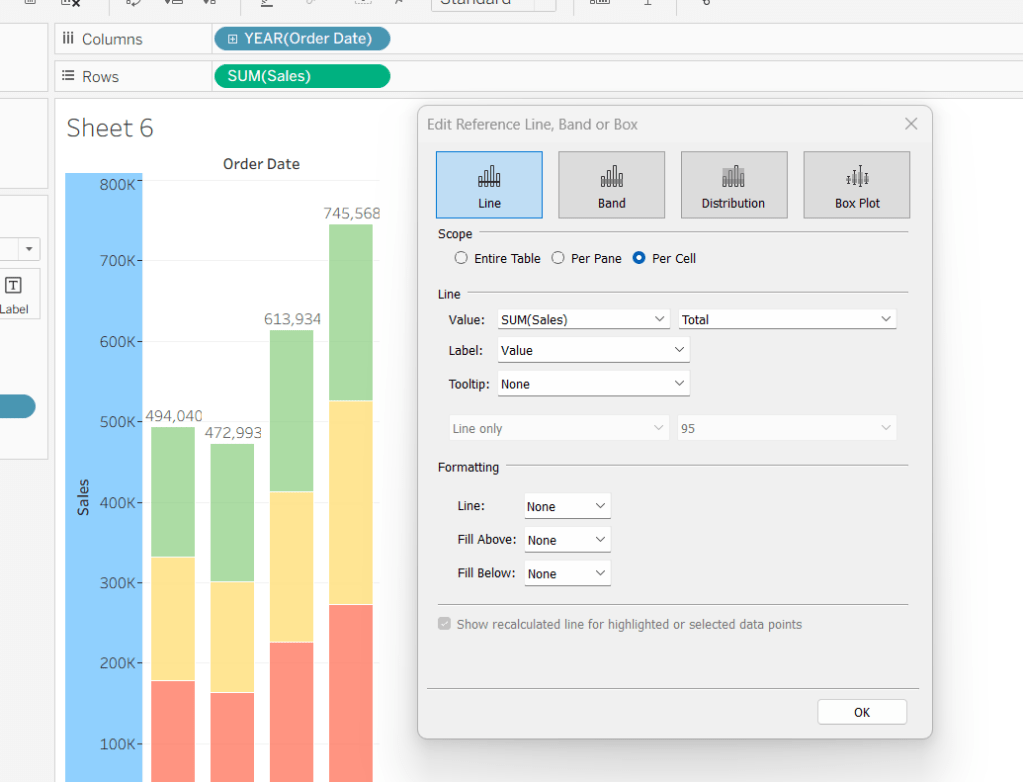
Add a reference line to the Sales axis that displays the value of TotalSales per cell
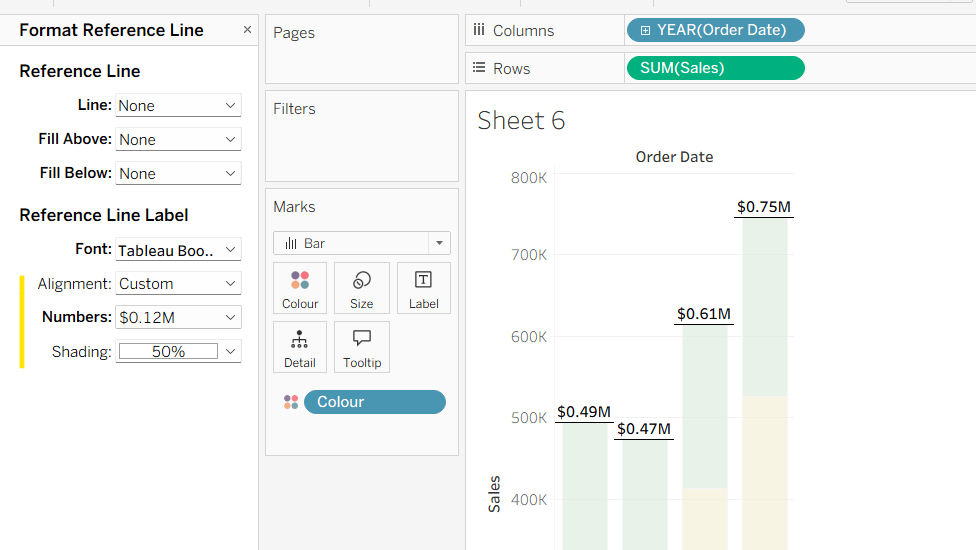
Format the reference line to format the displayed number in $M and bold font, and align top middle.
Create a new field
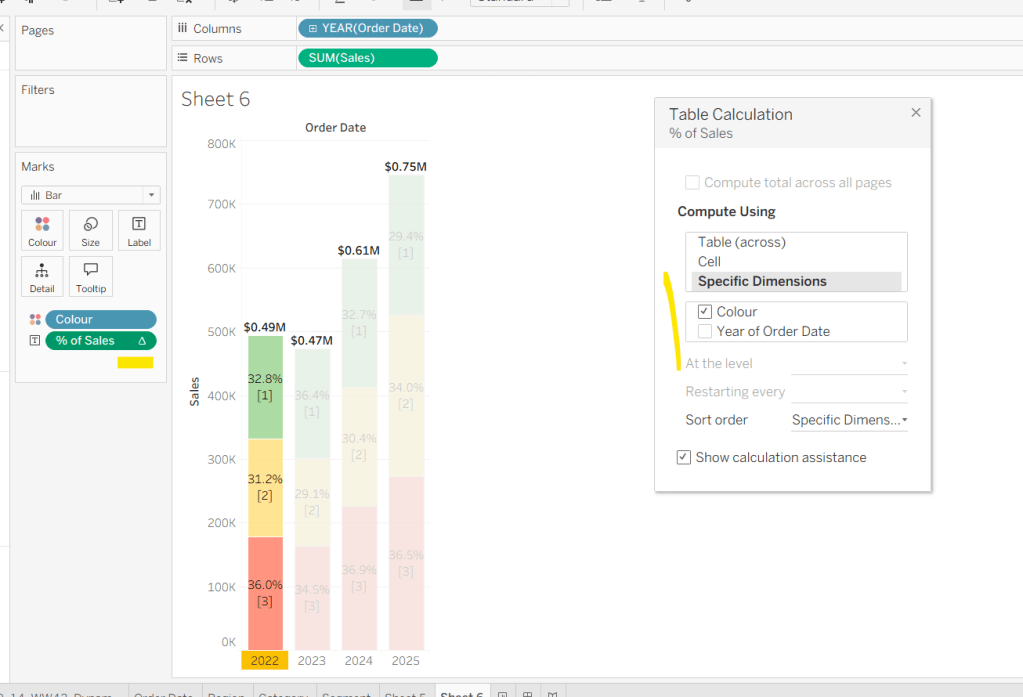
% of Sales
IF SUM([Sales]) / TOTAL(SUM([Sales])) <> 1 THEN SUM([Sales]) / TOTAL(SUM([Sales])) END
and format to % to 1dp. This will only display a value if its not 100%.
Add this to the Label. Adjust the table calculation setting so it is computing by the Colour field only.
Adjust the Label so the font is bold and the label only appears when Highlighted. Then update the Tooltip as required.
Although not explicitly called out in the requirements, I noted that if Yusuke clicked on the chart title, it reset the dimension to colour by. To deal with this we need to create
param Order Date
‘Order Date’
Add this to the Detail shelf.
We also need to ‘fake’ the title to be part of the chart itself (so it’s clickable). Double click into the Columns and manually type ‘Sales by Order Date’ and position the pill created before Order Date.
Right click on the column label (the text in darker font) and hide field labels for columns. Then right click on the column label to format – set the font to 12pt and bold, align left and shade the background to light grey. Increase the width of the column heading.
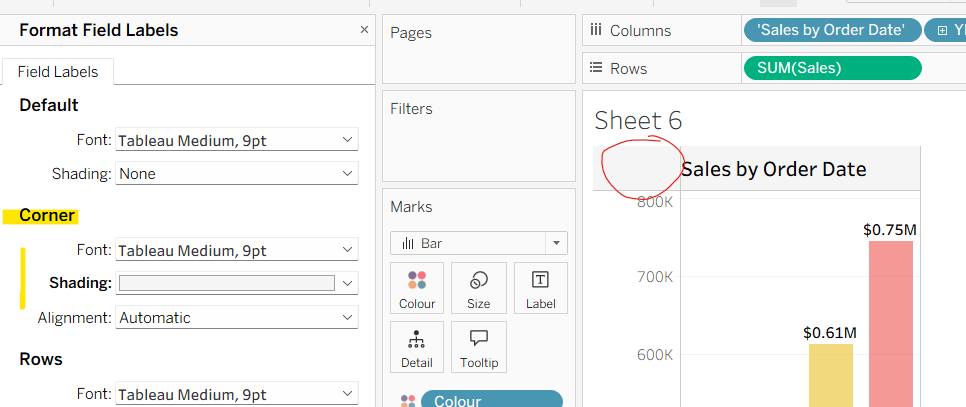
Then right click on the corner whitespace next to the heading just created, and format. Apply a light grey shading to the corner too.
If the ‘title’ is clicked, we don’t want it to be ‘highlighted’/’selected’. For this we will need fields
True
TRUE
False
FALSE
Add both of these to the Detail shelf.
Finally tidy up by removing the axis title, adjusting the font of the axis labels (I made them a bit darker), and removing row & column dividers. Name the sheet Order Date or similar.
Building the Region chart
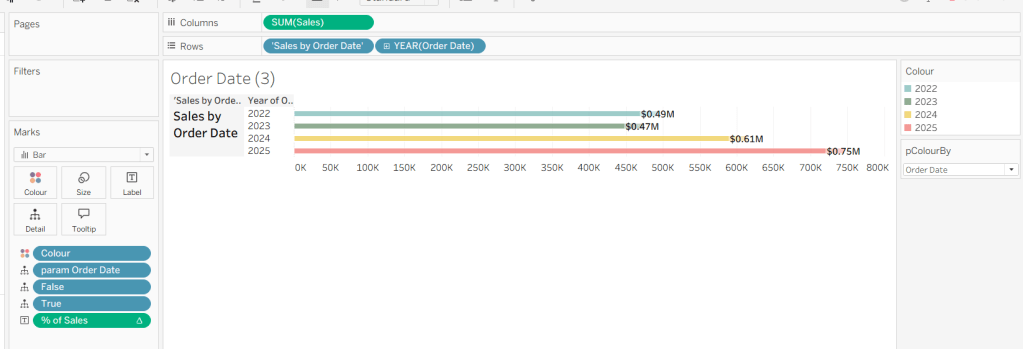
Duplicate the Order Date chart and then click the option in the menu to swap axis so we have a horizontal bar chart.
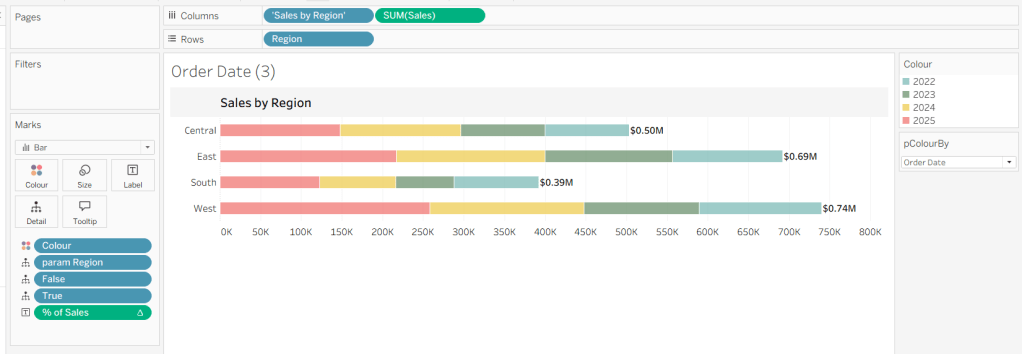
Move the ‘Sales by Order Date’ pill from Rows to Columns and update the text to become ‘Sales by Region’ instead. Drag the Region pill and drop it directly over the Order Date pill on the Rows so it replaces it and all references to the field are replaced too. Widen the rows.
Right click on the ‘Region’ text in the column heading and hide field labels for rows. Format the reference line to align middle right.
Create a new field
param Region
‘Region’
and add this to the Detail shelf instead of the param Order Date field. Name the sheet Region or similar
Building the Category Chart
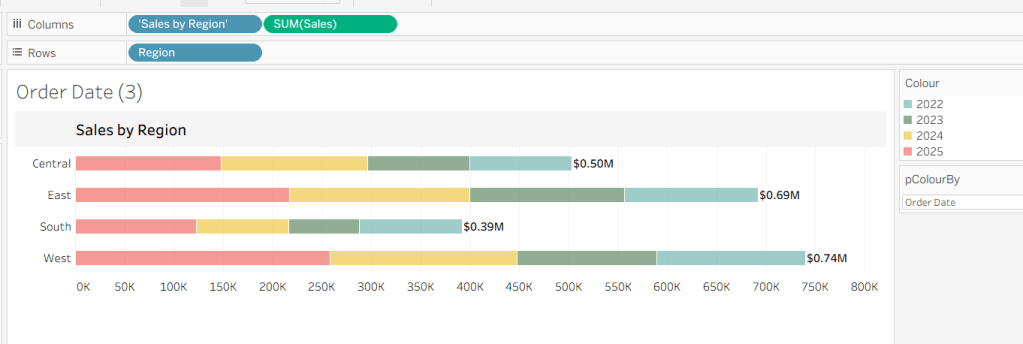
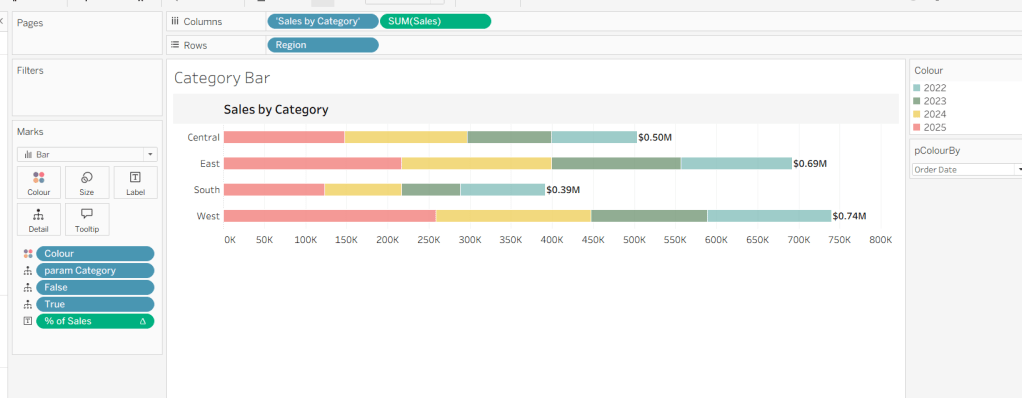
Duplicate the Region chart, and go through similar steps described above so the ‘title’ is Sales by Category and a new field
param Category
‘Category’
replaces param Region on the Detail shelf.
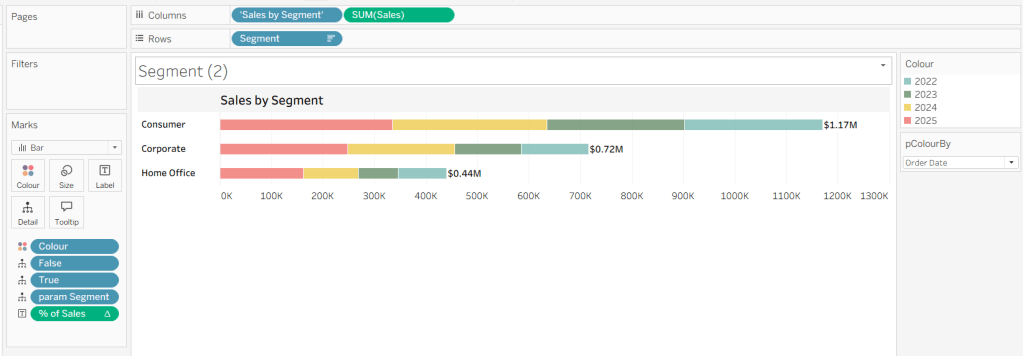
Building the Segment Chart
Repeat as above, this time setting the ‘title’ to Sales by Segment and a new field
param Segment
‘Segment’
replaces param Region on the Detail shelf.
Adding the interactivity
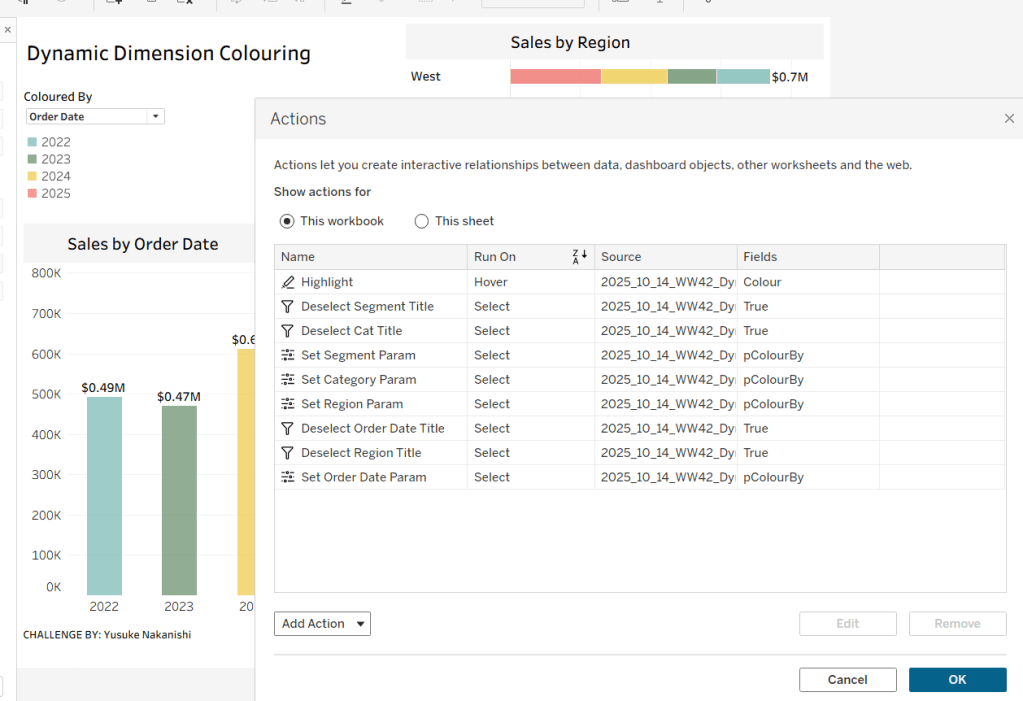
Add the sheets to a dashboard using layout containers and padding to organise as required. Then create the following dashboard actions
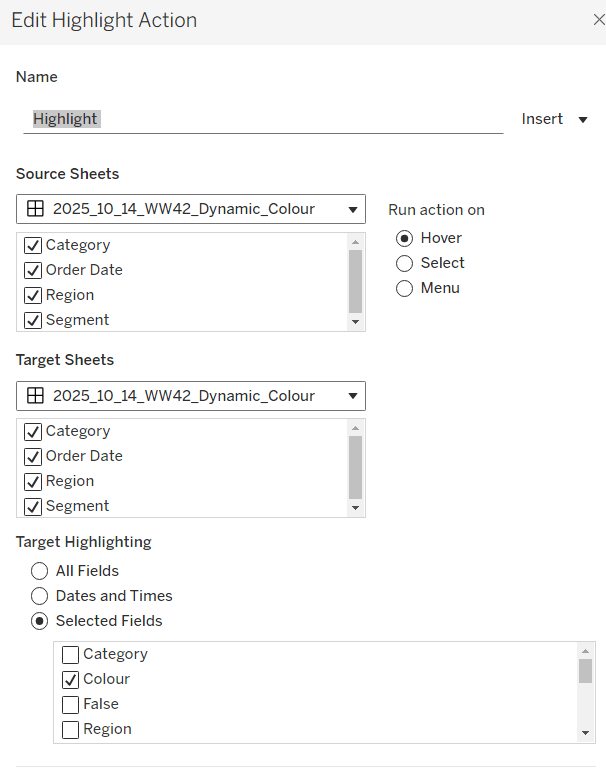
Highlight Action :Highlight
On hover of any of the charts on the dashboard, target all other charts, highlighting based on the Colour field only.
This action makes all the % labels appear when the mouse cursor is moved over the bars.
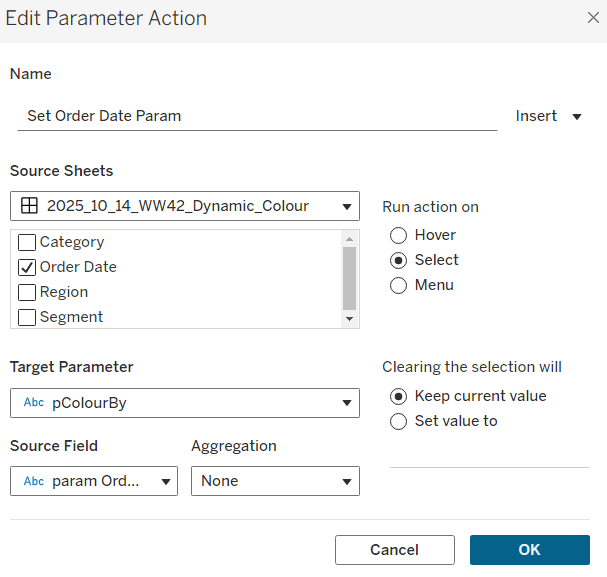
Parameter Action : Set Order Date Param
On Select of the Order Date sheet, set the pColourBy parameter with the value from the param Order Date field.
Parameter Action : Set Region Param
On Select of the Region sheet, set the pColourBy parameter with the value from the param Region field.
Parameter Action : Set Category Param
On Select of the Category sheet, set the pColourBy parameter with the value from the param Category field.
Parameter Action : Set Segment Param
On Select of the Segment sheet, set the pColourBy parameter with the value from the param Segment field.
These actions change the value displayed in the pColourBy parameter when the ‘title’ of the charts is clicked on.
Filter Action: Deselect Order Date Title
On select of the Order Date sheet on the dashboard, target the Order Date worksheet directly, passing the selected values of True = False. Show all values when selection is cleared.
Filter Action: Deselect Region Title
On select of the Region sheet on the dashboard, target the Region worksheet directly, passing the selected values of True = False. Show all values when selection is cleared.
Filter Action: Deselect Category Title
On select of the Category sheet on the dashboard, target the Categoryworksheet directly, passing the selected values of True = False. Show all values when selection is cleared.
Filter Action: Deselect Segment Title
On select of the Segment sheet on the dashboard, target the Segment worksheet directly, passing the selected values of True = False. Show all values when selection is cleared.
And once these have all been applied, you should have a functioning dashboard. My published version is here.







 Donna + DataViz